//BIO-ARCHITECTONICBA
--:--:-- KST

//BIO-ARCHITECTONIC

바이오아키텍토닉
EVALUATION & VERIFICATION LAB FOR MEDICINE
~/bio-architectonic $ treelast updated: 10.10.2026
evaluation-verification/
├── generated-heart-anatomy-audit
Statusposter accepted · KoSAIM 2026
Specification-based audit of AI-generated 3D heart models.
├── evaluation-harness
Statusanalysis complete · manuscript in progress
Multi-gate evaluation of local language models on professional medical prompts.
├── evidica
Versionv1.2.4 · OSS (MIT) · released 2026.09.22
Local literature-review workspace with no language model inside. Every claim is tied to the exact passage a person chose.
└── onpremises-capacity-curve
Statusruns complete · analysis in progress
Throughput, wall power, and accuracy of local models on four on-premises machines.
medical-devices/
├── cochlear-implant
PatentKR 10-2849110 · granted 2025.08.21 · US pending
Closed-loop signal processing for cochlear implants.
├── communication-brooch
Patentpending · 2026.08.04
Design right3 pending
Brooch-shaped communication wearable for people who can no longer speak.
└── more devices in development
lab/
├── README
FounderJeong-Pyo Han
Independent research lab for model evaluation and verification, applied to medicine.
├── about
Background and how the lab works.
├── contact
└── elsewhere
~/bio-architectonic $
ABOUT · BIO-ARCHITECTONIC

An evaluation and verification lab for medicine.

BIO-ARCHITECTONIC studies how AI systems fail and how to check what they produce. The same verification discipline runs through its medical devices.

ABOUT

Measure where models fail. Verify what they make.

Each project starts from a question a clinician or researcher would ask, then builds the instrument that answers it: an evaluation harness, a measurement rig, an evidence trail. Public results come with their data, methods, and DOIs.

How the lab works · A one-person lab by design. I set the question, brainstorm, design the experiment, and run it. Custom agents work as lab partners, taking on tasks that range from back-and-forth working sessions to checking each step of an experiment. They also support the data analysis that becomes papers, and hardware design. Day-to-day work runs on the lab's own orchestration system.

FOUNDER · RESEARCH ENGINEER
Jeong-Pyo Han 한정표
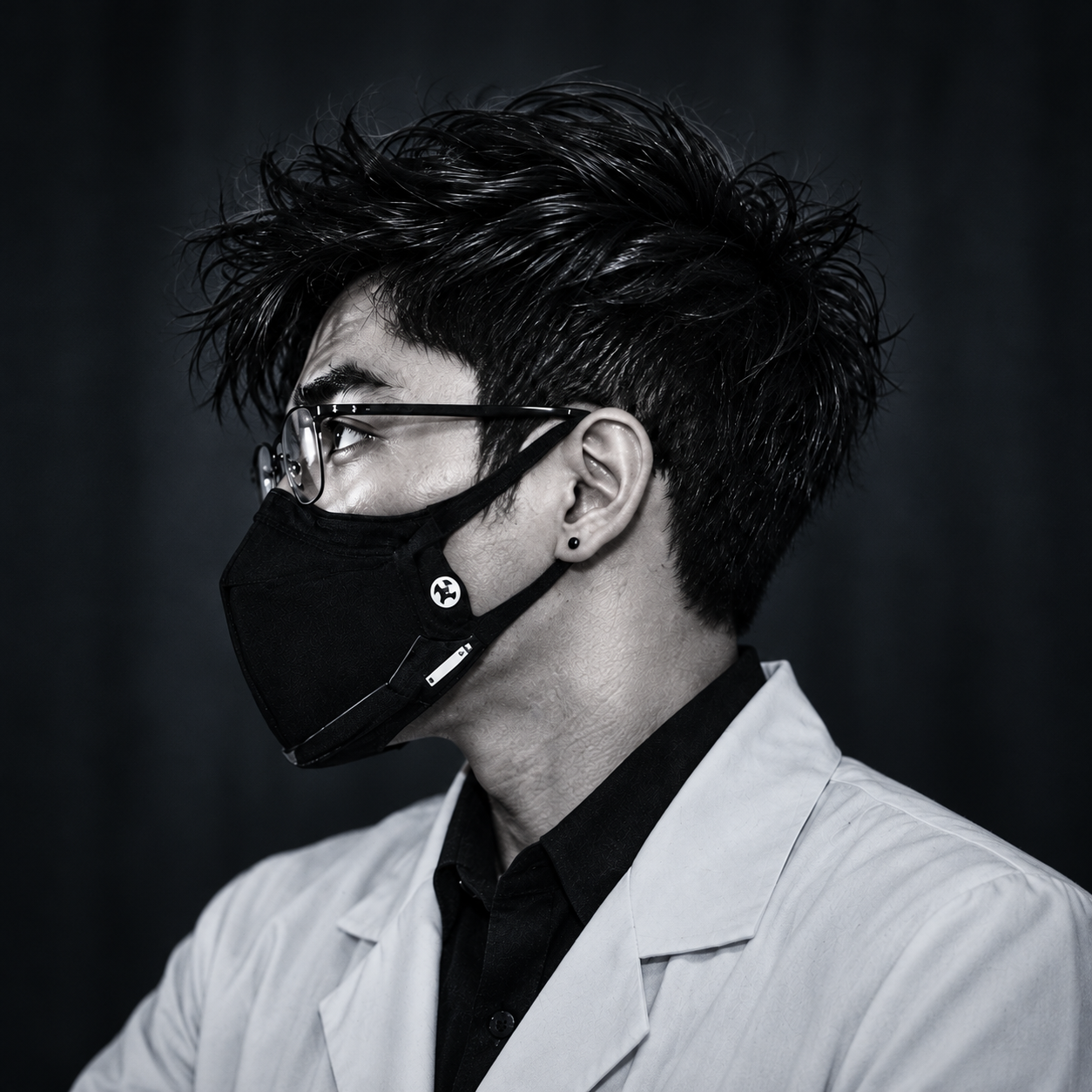
Portrait of Jeong-Pyo Han

MD candidate at St. George's University School of Medicine (Class of 2030), aiming for cardiothoracic surgery, and an academic leader there. BS in Neurobiology and Neuroscience from the University of Southern California (2024, magna cum laude, Renaissance Scholar, most outstanding student award in biology), with a first-author student paper from his undergraduate years (AJOSR, 2025).

Before medicine, an audio engineer trained in analog audio electronics and Python (Indiana University Jacobs School of Music, 2015 to 2017; University of Southern California, 2020 to 2021). That engineering now runs through his research and inventions in medicine. His audio signal-processing work became a cochlear implant patent, filed before medical school, granted in Korea in 2025 and pending in the US since 2026 (sole inventor).

Operational discipline from a Republic of Korea Air Force counter-terrorism unit (SDT): first place in the Weapons Skills category of the ROK Counter-Terrorism Tactical Competition (2019), and two challenge coins from the United States Air Force for operational skill (2018, 2023).

RESEARCH · EVIDENCE STAGES

Selected work, labeled by stage.

Each item states its actual stage. Evaluation work shows its method and scale; results appear once they are public, linked to code, data, or a DOI.

EVALUATION & VERIFICATION

Where models fail, measured.

The core of the lab: evaluation harnesses, measurement studies, and evidence tooling, each with its method stated.

Generated heart anatomy audit MEDICAL AI EVALUATION · PILOT STUDY POSTER · KoSAIM 2026

Generative AI tools can now produce 3D heart models from a prompt. Each generated model is audited against a formal specification of measurable structural invariants. The pilot study was accepted for poster presentation at the Korean Society of Artificial Intelligence in Medicine (KoSAIM) 2026 conference (Seoul, October 23).

FINDING
Silent failure
Of 18 generated models, 16 failed the closed-surface target of genus zero (no handles), while the generator's own responses reported success. In this pilot, no difference in genus was detected across prompt specificity levels (Kruskal-Wallis p=0.64 in the primary analysis, p=0.79 in the sensitivity analysis). Pass and fail describe surface topology only, not anatomical validity.
Heart from the same generation pipeline, simplified for display. Not one of the audited models. Drag to rotate.
specification-basedgeometric auditgenerative 3Dheart anatomysilent failure
Evaluation harness MEDICAL PROMPTS · MULTI-GATE EVALUATION MANUSCRIPT IN PROGRESS

A harness that puts local language models through five gates before any accuracy score counts. The prompts are professional medical questions, while the gates apply to any domain. The corpus holds 6,600 recorded model calls from three studies. Every count was re-tallied from the raw records in independent passes, then checked in a blind audit. Data analysis is complete and the manuscript is in progress.

6,600 CALLS 3 STUDIES 5 GATES ANALYSIS COMPLETE
medical promptslocal modelsautomated judgingindependent re-tallyblind audit
6,600 model callsGATE 1GATE 2GATE 3GATE 4GATE 5accuracy countsFIVE GATES · ANY DOMAIN
Schematic. Accuracy counts only after the five gates.
Evidica EVIDENCE TOOLING · v1.2.4 OPEN SOURCE · MIT

A local literature-review workspace: search, screening, citations, and a manuscript editor in which every claim is tied to the exact passage a person chose, with that decision kept on record. Built for a real review on congenital tricuspid valve malformation and 22q11.2 deletion syndrome; version 1.0.0 went to a university research lab in July 2026.

FEATURE
Evidence Chain
Each claim stays linked to its source passages, its managed citation, and the human review history. Attaching a passage freezes its quote, page, and file hash and records a human role and note. If the claim text drifts, the source file changes, or a citation is edited by hand, review stays locked until a person resolves it. Evidica does not judge whether a claim is true, and there is no language model inside.
Evidica app icon
Walkthrough · 23 seconds · synthetic demo data
ONE LOCAL APP · THREE SQLITE STORESLiterature APIsPubMed · Europe PMC · OpenAlexsearchevidica.dbLibraryone source of truthFull-text routesUnpaywall → Europe PMCindex PDFsevidica_index.dbPDF passage indexBM25 · rebuildableYour PDFsdirect upload · SHA-256extract locallyevidica_manuscripts.dbManuscript + Evidence Chainhash-linked event ledgerObsidian notesoptional · syncExportsLibrary · Search History · References · Evidence Chain auditno generative model anywhere · retrieval is local BM25 · review is human-only
no language model insidelocal-firstEvidence ChainBM25 passage searchprovenance
On-premises capacity curve MEASUREMENT STUDY · LOCAL INFERENCE ANALYSIS IN PROGRESS

A clinical language model kept on an institution's own machines still has a running cost, the power it draws at the wall. Throughput, wall power, and accuracy on medical tasks are measured together on four desk-side machines (24 to 128 GB of memory). One plug meter is read by two independent recorders, and every value traces back to hash-pinned records. Result figures are held for the paper, and a preprint is planned.

RUNS COMPLETE 4 MACHINES 2 MODELS × 12 QUANTIZATION LEVELS 15 MIN PER CONFIGURATION PROTOCOL FIXED IN ADVANCE
on-premwall powerquantizationfour machineshash-pinned records
machine under test1 of 4 · 24 to 128 GBplug meterwall powerrecorder Aindependentrecorder Bindependenthash-pinned recordsevery value traceable
Measurement setup, schematic. Result figures are held for the paper.
MEDICAL DEVICES

The same discipline, in hardware.

Devices from the lab's medical track. Hardware is filed before it is shown, so each device shows its filing stage.

Cochlear Implant System MEDICAL DEVICE · CLOSED-LOOP CONTROL PATENT GRANTED

Cochlear Implant System and Method of Controlling the Same. The external unit measures what the user can hear, folds the band beyond that limit back inside it while preserving its shape, and reads the implant's state back through the same coil to adapt. Sole inventor. Drawings redrawn from the granted filing.

KR 102849110B1 · GRANTED 2025.08.21 US · PENDING 2026.06 SOLE INVENTOR
01 · PLACEMENT External and internal units couple magnetically across the skin
200 External unit · sound processor
100 Implant · receiver coil + electrode array
FIG. 1 redrawn
02 · CLOSED-LOOP SIGNAL CHAIN The controller adapts on state read back · not one-way delivery SKIN 220 MIC 230 MODULATOR 240 CONTROLLER 250 TRANSMITTER 210 COIL 100 IMPLANT 260 CHAR. DETECTOR adapt
FIG. 3 redrawn · feedback path emphasised
03 · FOLDING THE INAUDIBLE BAND Content out to F2 folded inside the audible limit F1, shape preserved LEVEL FREQUENCY original · beyond audible S1 S2 F1 F2 ★ audible limit
FIGS. 5 to 8 condensed
S100 to S200 MEASURE A first test signal detects the user's hearing characteristics; the modulation algorithm is chosen from them.
S300 to S500 MODULATE Sound from the microphone is folded into the audible band, modulated, and transmitted to the implant.
S600 to S700 VERIFY A second test signal reads the implant's state; a notification is raised if it drifts.
★ marks the audible limit (the set-point).
Communication Brooch MEDICAL DEVICE · TOUCH AND BODY SIGNALS PATENT PENDING

A brooch about 5 cm across for people who still understand but can no longer speak. Typical users are recovering from a stroke, live with Parkinson's disease or ALS, or have a tracheostomy. Two touch pads select one of ten messages (six needs, three feelings, one call for attention) on the brooch's light display. When the wearer cannot touch, the same display calls for attention from heart-rate and motion signals, checking with the wearer before a caregiver is alerted. Everything runs on the brooch, with no cloud.

Stage · The interaction is built in firmware and verified in a simulator, and a four-layer development board is designed.

KR PATENT · FILED 2026.08.04 KR DESIGN RIGHTS × 3 · FILED 2026.08.04 PITCH DECK SUBMITTED · SEOUL CENTER FOR CREATIVE ECONOMY & INNOVATION · 2026
2 touch padsselect a messagebody signalsheart rate · motionlight display1 of 10 messagesattention callsame light displaycheck with wearercaregiver alertON THE BROOCH
Interaction schematic, not the product design. Ten messages: six needs, three feelings, one call.
Additional medical devices are in development and will appear here once filed.
GUESTBOOK · SITE PREVIEW

Leave a mark.

This guestbook is part of the site build and is not publicly deployed yet.

HOUSE RULES
  • The owner does not post entries here. Replies under an entry are the only thing written by BIO-ARCHITECTONIC.
  • Links are stripped automatically. This is not censorship of opinion. It keeps visitors from following an unknown address off this page.
  • Entries that are unlawful, abusive, or commercial spam will be removed. If the room stops being worth keeping open, it closes temporarily.
  • No account, no email, no tracking. A name and a message, nothing stored beyond that.
0/12
MARK
0/300

MODERATOR